
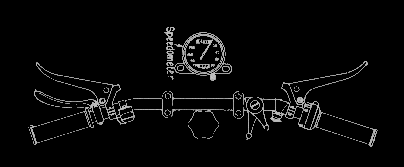
Vincent Instruments -
Speedo
- Tachometer - Cables
http://archives.jampot.dk/Technical/Speedo/Smiths_Speedo_restoration.pdf
http://velobanjogent.blogspot.com/2008/03/smiths-chronometric-speedometer-and_21.html
ernie lowinger 3/18/10
The objective is to remove the bezel without distorting or destroying the beauty chrome. The bezels on most speedos and tachs are quite thin, and usually made of brass. Brass plates well, requiring no copper, so the bezels are normally nickel plated, then beauty chromed.
The best way to remove the bezel without damage takes a couple of days. The first day is consumed with the bezel in a penetrant soak. Fill a sauce pan about 1" deep with a good penetrant, then place the instrument face down in the penetrant. After about six hours remove the instrument, and with a razor blade, try to remove the gasket between the bezel lip and the instrument face glass. The gaskets are usually rubber or paper. The purpose of removing the gasket is to allow passage of the penetrant to the threads in the opposite direction from the external soak. Replace the instrument in the penetrant bath and wait until morning.
Remove and dry the instrument. Wrap the outer circumference of the bezel three times with 1/2" masking tape. With a rawhide mallet you can now tap lightly around the circumference of the bezel. As the brass bezel is thin and relatively soft, the rawhide's light blow easily disturbs the female and male threads, and loosens any corrosion grip. Don't tap on the bezel's glass flange, especially with the gasket removed. It only takes a slightly enthusiastic blow with a mallet to cause the bezel to jump thread, thereby causing a cross threading of the bezel. The masking tape protects the beauty chrome from damage. Any blow on the bezel without this protection will inevitably cause chrome luster loss due to abrasion.
The next step is to mount the instrument securely so the bezel can be removed. The Shadow speedo can easily be mounted in a vise with the mounting plate still attached. The Rapide speedo can be mounted as well in a vise, leaving the mounting plate attached.
The trouble with a strap wrench is that the cam action required to tighten causes a hard pressure point on the circumference of the bezel at the point of the cam action. The best method is to modify a ring compressor. This would be the type that has a ratchet band around an expandable, contractible, metal cylinder. The modification is to shorten the ring compressor to the tightening ratchet band.
With the protective masking tape still in place you can proceed. The masking tape serves two purposes, it provides a high friction coefficient surface and protection to the beauty chrome. Place the ring compressor over the bezel, lining up the bottom of the bezel with the bottom of the ring compressor ratchet tightening band. Now tighten the ring compressor. The ratchet portion of the ring compressor protrudes out about a half an inch, and provides a surface that can be tapped on with a rawhide mallet. The tapping acts like an impact wrench, and breaks the bezel loose with ease. If the bezel turns with difficulty it's usually because you have the ring compressor too tight. Loosen, and the bezel can be removed with no problem, and if you use this method zero damage will be incurred.
Max Lambky 2/21/10
Max has written a whole series of restoration
articles posted in the Misc. Tech Section. Well worth reading.
Good article on
chronometric
Speedometers:
MPH 653, June 2003. 10/31/08
1680xN Divide by R = T.P.M. No
Were N= Number of turns of the inner shaft of the speedo cable for 6 turns of the wheel that drives the cable and R= the radius of the wheel in inches measured from the centre of the hub to the ground. Example - Cardboard pointer on inner shaft rotates 12 1/2 turns as vehicle is pushed forward 6 turns of rear wheel - I say pushed forward so as to illustrate the need to allow for the differential gearing in a car - a chalk mark on the tyre helps here also. Grandchildren can help count the rotations of the cardboard pointer - or do the pushing!
Wheel radius is 13"
Flex turns per mile =
1680 x 12.5 divide by 13 = 1616 T.P.M.
For a metric - kilometer - speedo substitute
1680 for 2653 and measure wheel radius in centimeters
Example 2653 x 12.5 divide by 33 = 1005
T.P.K.
The TPM or TPK figure is on a lot of dials but not all.
Andrew Rackstraw 10/25/02
This type of end cap is normally connected to a kill switch - mounted up on the handle bar - the kill switch is used to short the centre of the armature to earth and thus kill the engine - horrid things and not recommended - the switch will inevitably goes wrong and is guaranteed to give you a sore right leg. Vincent's are supposed to be switched off by holding the valve lifter open when the engine is at idle speed. If you were to connect a multimeter - select AC Volts - to this pickup and the body of the magneto you would be able to record a voltage that is directly proportional to the speed of the magneto. Unfortunately the voltage is in Alternating Currant - AC - form and will require a full wave rectifier so that a standard Direct Currant - DC - voltmeter can be used.
Select a suitable rugged vibration resistant voltmeter. It is now possible to paint a dial to indicate Revolutions Per Minute - not an underground political organisation! - to fit the voltmeter. Andrew Rackstraw 2/20/02
5 inch dia 150 mph
speedo
S515/L
5 inch dia 240 kph
speedo
S515K/L
Series D 3 inch 150
mph
S576/L
Series D 3 inch 240
kph
S 576K/L
Series C 3 inch 120
mph
S433/3/L
Series C 3 inch 180
kph
S433/7/L
Doug Wood 11/24/01
Speedometer
Calibration
using GPS: The modern navigational aid
the 'GPS' is now readily available and now that the satellites are not
giving us a corrupted signal they can indicate our speed much more
accurately
than any speedometer on our vehicle ever did. There are draw backs to
this
method of measurement though:
1. The response to changing of speed is a bit
slow
2. The GPS has difficulty indicating changes
of direction
3. The GPS is still a power hungry device and
can chew through a set of batteries fairly quickly
If you want to calibrate your speedo using one
of these GPS's:
1. Mount the instrument so that it is as near
horizontal for the built in antenna to pick up the satellite signal
2. Insert a fresh set of batteries in the
instrument
3. When measuring your speed try to travel in
a straight line
4. Measure your speed only when travelling at
a constant speed
5. Don't do anything dangerous and then blame
me because I presume you are smart enough not to mount the GPS so that
its difficult to see and not try reading it in
dangerous traffic situations.
You can now compare the two speeds - the GPS
speed
is deadly accurate and can be regarded as a standard.
Andrew Rackstraw 06/15/01
Speedometer
Disassembly
and Cleaning: Smith's assembled the speedo in a set way and
if you try assembling it any other way it becomes extremely frustrating
so first lets go through the Smiths way then I will tell you an
alternative
!
Smiths assembled the instrument movement into the case - tested it -
made any adjustment for calibration then fitted the dial and the
needle.
If you should want to try this method the biggest obstacle is to -
removing
the needle without damaging the dial or
the needle. The easiest method to accomplish this is to place
a 3/16" wide flat bladed screwdriver under the dial - place it
between the brass top plate of the chronometric movement and twist
the blade in such a way that the side of the blade closest to the
needle
shaft is forced up against the dial - Oh! - remove the 4 dial screws
first
won't you ?
The needle will shoot across the room scare the cat and be lost forever so don't forget to put your finger on the needle to prevent 'feline agro' now you can replace the movement into the case and apply pressure to the reset shaft from inside the case in order to replace the 12 BA screw - the head of which should be flush with the reset knob sleeve - to prevent the screw head gouging out the alloy of the case in that area
Please be careful with this reset shaft - none of the other models
of
this type - i.e. 3" - have a tapped hole for the tiny screw - they are
just plane holes for the tiny split pin and all shafts are
hardened
- easily and often broken. Now that you have all that done the
next
trick is to clean up the dial with an old tea towel and spit - yes that
right - and clean with a circular movements abought florin size circles
till the towel removes no more filth and all the numbers are nice and
white
- STOP immediately if you
start removing numbers - which can happen with poorly painted dials
and the paint has oxidised - test in an unimportant area first - if at
this stage you are tempted to have a go at cleaning the odometer wheels
be careful because you will move the wheels very easily and lose your
original
mileage they will move in one direction only - back to zero to move no
more - you also run the risk of bending the comb spring under the
odometer
wheels.
Now replace your dial - the right way up - and the 4 tiny UNC screws
that hold the dial in place - replace the needle on its shaft very
lightly
- now turn the drive shaft with a bit of old speedo inner cable in the
direction it is turned by the front wheel - anti clock - twist the
cable
between your fingers fast enough for the needle to advance a small
amount
- now twist the cable
nice and slow till the needle moves back - gently pull the needle from
its shaft and replace it lightly so that it is now pointing to 10 mph
on
5" Black Shadow speedo's and 5 mph on 3" speedo's - repeat this
test
till you are absolutely sure you have the needle in its proper place
now
give the centre a firm tap with the plastic handle of your 3/16"
screwdriver
this will secure the needle on its taper nice and tight.
Peer
sideways across the dial to make sure the point of the needle will not
foul the dial screws - if in doubt tweak the needle very gently away
from
the dial - it is only soft alloy so be careful.
As a nice finishing touch you could try painting the needle with a sharpened matchstick and some enamel paint - I like the Humbrol paint gloss white - use the smallest quantity working from the centre outwards paint before assembly - best!
Now for the unofficial method - Pull the reset shaft out of the speedo case hold it in this extended position with a sharpened screwdriver blade whilst at the same time placing the reset knob on the shaft and placing the 12 BA screw into place with a pair of pointed tweezers and once in place - tighten up the 12 BA screw - test and hope to hell it all works cos if doesn't you will have to revert to the first method and put things right under the dial. Andrew Rackstraw 05/05/01
The ammeter is an indicator of the state of our battery and consumes no power! By reading the amount of charge going into the battery we can interpret this into the state of the battery and because the ammeter is wired via the voltage regulator it is automatically switched off when the engine stops - an ammeter is in series with the circuit and a voltmeter is in parallel with the battery.
There are a couple of types of voltmeter out there the most common is a meter that has a scale ranging from 8 to 16 volts - this is quite difficult to achieve with a moving coil type of meter - the advantage is that there is a large movement of the needle over the range we are interested in - if there wasn't a large movement we would not be able to see the critical voltage we are interested in - like 13.8 volts - unless we had a very big instrument - the reason for a 5" speedo for 150 mph dials. The most common type of instrument is one that works on a bi metallic strip principle - the strip is heated by a very small winding wrapped round it and depending on the state of the battery is the amount of heat generated and the amount of deflection of the strip and now this moves the needle pivoted at the end of the strip.
This type of instrument is quite cheap and can be found in temperature - fuel - and voltage gauges - on any car dashboard - I can not vouch for their ruggedness and suspect that the vibration from the old bike would soon wreck an instrument of this nature - I am always amazed at some people attempting to mount delicate clock movements to the vibrating handlebars of their bikes - I digress!!
There are some rather neat solid state voltmeters that indicate battery voltage by changing LED colours depending on voltage - very very small currant drain and remarkably accurate - this solid state device is used to switch the charger on and off on your cell phone - too modern for our old bike. There are other types of voltmeter out there but none of them are simple. Perhaps they knew what they were doing and the kiss principle is best after all. Andrew Rackstraw 05/28/01
In my experience most indicator (a.k.a.
"idiot")
lights activate on battery discharge not on low voltage.
Extending
this concept to an ammeter versus a voltmeter one might get an earlier
warning that something is amiss. In other words a warning that
your
battery is discharging, not that it has already discharged.
Doug Wood 05/29/01
 bracket
atop the forks. Remove the screws that enter from the rear of
case.
Carefully, wearing a leather glove for grip, unscrew the chrome
bezel.
If dead resistant to turning, dribble a bit of light oil (WD-40 or 3
in1)
into its threads, let sit face down for the oil to ooze down into
the threads. Retry to unscrew the bezel. The
reset
knob is secured to its shaft with a tiny
bracket
atop the forks. Remove the screws that enter from the rear of
case.
Carefully, wearing a leather glove for grip, unscrew the chrome
bezel.
If dead resistant to turning, dribble a bit of light oil (WD-40 or 3
in1)
into its threads, let sit face down for the oil to ooze down into
the threads. Retry to unscrew the bezel. The
reset
knob is secured to its shaft with a tiny
They make a drive unit both clockwise and anti
clockwise not exact copy but close and it stays working cost 3 years
ago
aprox Stg£50.00 others were looking £90.00 for it
Speedograph
actually manufacture them. Henry Martini
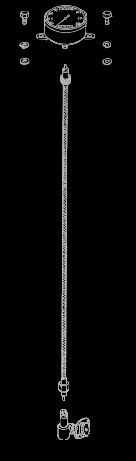
The speedometer drive
tube was never used on post war
models.
The "A" speedo tube it's 'king wierd and rather silly, and has no
advantage
over the proper cables that I can see. Infact the pre-war speedos use a
Jaeger fitting (not a screw) which is a plain output (male) spindle
with
a cross drilling through it. The corresponding female part is attached
to and part of the inner and its "head" is a turned component with a
cross
drilling through which one passes a split pin. This pin of course goes
through the male item as well . The brake end is what you would call
standard.
Arthur Farrow 02/27/01
Speedometers: The
numbers
on the face of Speedo's are the model number and the variant of
that model ('L') there seems to be no convention or logic in the
symbols
used and this is fairly typical of Smiths, the variations are for
things
like shape of the bezel, light or no light, the position of the re-set
for trip mileage or even no trip mileage recorder supplied.
The early 5" speedo (and Sunbeam 3" Speedo's) had a problem with
right
angle gear box - they were prone to seize when the bike was wheeled
backwards
- I some times wonder just how many did actually have this problem -
the
second version (MkII) of this speedo had a different gear box that
required
a larger recess in the 5" case for its different shape, so it is
difficult
to
modify early Speedo's and so there would still be a number of the early
Speedo's still out there. The MkII also had a different frame for the
guts
of the instrument but exactly the same gears in the gear box! I
am
at a loss to know how this actually solved the problem.
When I have a 5" for repair and I have no spares, I modify the speedo by changing the frame and converting the speedo to straight drive and then fit an after market gearbox made by Smiths for some Rover 2000 cars and export Austin/Morris 1100 /1300 cars (with the steering wheel on the wrong side!) stamped with the number BG2410/00 on the plate, this plate holds the knurled nut in place - remove the two tabs off this plate so that it will fit into the recess on the 5" casting - and finish the job by giving it a coat of black paint this somehow seems to disguise its ugliness. This is also the gear box/speedo combination used by the manufacturers like Autotempo when making 5" Speedo's.
There is no doubt the 5" 150mph instrument is an impressive looking instrument and no wonder they are fitted to so many models by their owners they should have been made to lie down a little and had a gearbox of a lesser angle giving a straighter line for the cable to that other poorly made gear box on the front wheel.
The trouble with the original gears is that they are too small for
the
job and should have been made twice as big at least - observe the same
angle gear box on the back of Japanese Speedo's - much better and
giving
no problems - the after market Smiths gearbox is expensive and also
poorly
made and prone to failure (and I can say anything I like after 46 years
of
Instrument Work!) the gears are made from a type 6 nylon and should
be lubricated with a synthetic grease like Silicone, the original steel
gears should be oiled with a high pressure (HP) gearbox oil.
The chronometric movement is the same in all chronometric Speedo's. They are fitted with different size gears for correct ratios on the odometer. The speedo part if the instrument (the chronometric movement) can be fitted with different Commander Pinion sizes and Weighted Escape Wheels for different Turns Per Mile ('TPM' on the dial of some Speedo's) so that they can be calibrated for 80 or 120 or 150 mph or kilometres ('TPK') or what ever takes your fancy. I have seen the same movement fitted to printing presses and hour meters. It should be over lubricated with engine oil not instrument oil. Never let it get dry and it will last many years if well oiled.
Chronometeric revolution counter's have a more substantial movement with larger pinions and different shaped brass plates and strong mounting method in order to withstand the vibration of a racer, therefore it is quite acceptable to use a lighter speedo movement in a non-vibrator as a rev counter.
Chronometric movements (with heavy hair springs) were developed to overcome the problem of vibration breaking the hair springs (of necessity light weight) on car type magnetic movements when used on bikes and were an expensive option in days of yore.
When I have a new batch of dial printed (silk screen) I never bother to print the model number on the dial. This way my customers don't get confused and I can use the same dial on the many models and their variants and it's a tidy looking job.
German speedos are not necessarily very well made, the worst are
from
France or Italy and American electronic speedo's on modern Harleys are
just
brilliant.
Andrew
Rackstraw 11/03/00
But help is at hand by shear coincidence the American wire gauge thread 10 x 32 UNF will screw right in, it is - in metric 0.78 pitch x 4.83mm diameter - make sure the thread is no longer than the original or there is a danger of the end of the screw foaling the movement the length of thread under the head is 9mm or 0.355in and the washer was a star washer 40 thou thick
Andrew Rackstraw 7/18/00
Again I've had a Rover type drive on the back of the Shadow speedo for ever as mine is a replica 5" clock, no problems if the lower box and cable are well lubricated. The Nilos rings are good stuff as well, they don't break up and grease you shoes.
Ian Savage 4/04/00