
Vincent
Technical Sections: -Serial
Numbers/Production- Photo Gallery of
Models - Brakes
- Engine
Overhaul - Vincent
Engines - Wheels/Fenders
- Instruments -
Transmission -
Clutch - Magneto - Tank/Seat - Suspension
- Tools - Norvin -
Electrics-
Carburetors - Misc - Links -Vincent
Parts/Services Suppliers - Polishing/Cleaning
- Shipping Vincents-Electric
Starter - Paint/Transfers
New Technical Section (just being developed ..these photos are hard to
work with.. I give up for now..)
NORVIN (a Vincent engine mounted in a Norton motorcycle
frame)
Last Edit: February 23, 2018
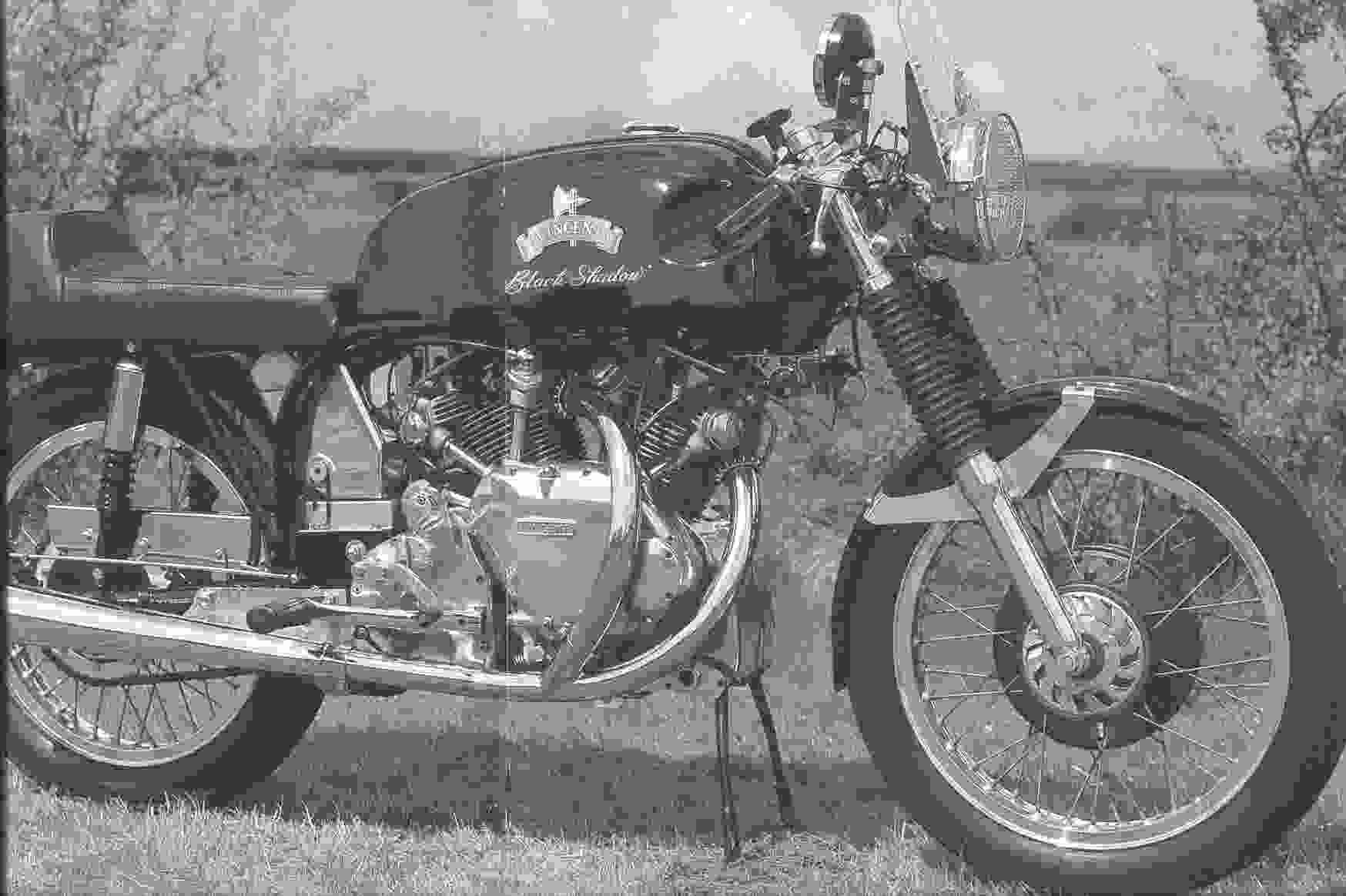
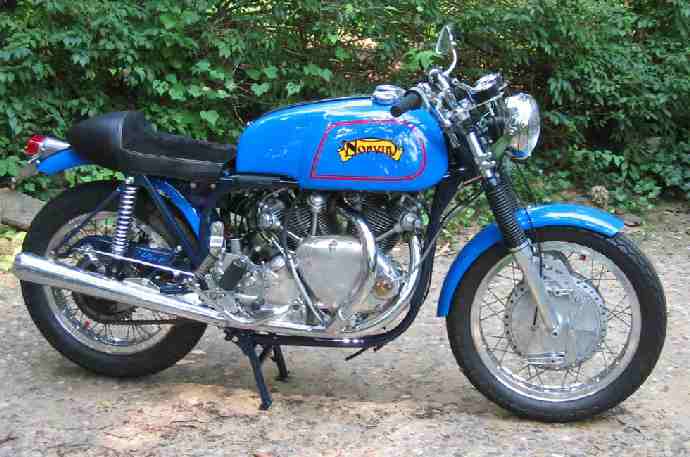
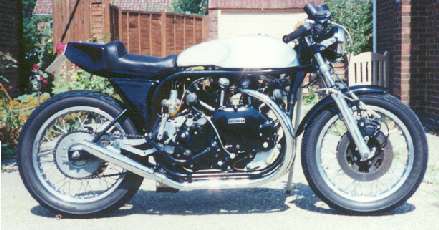
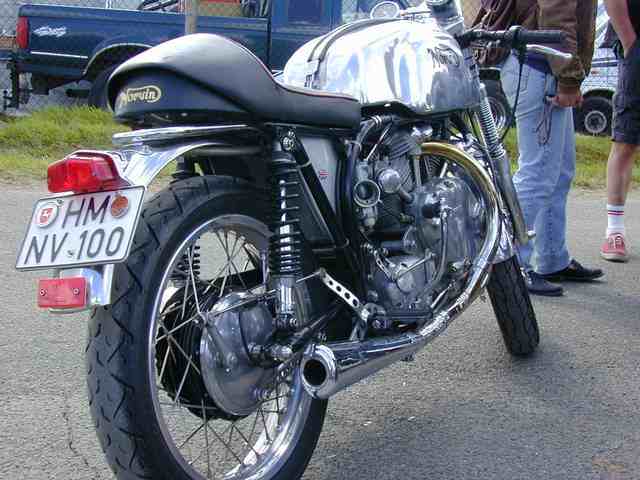
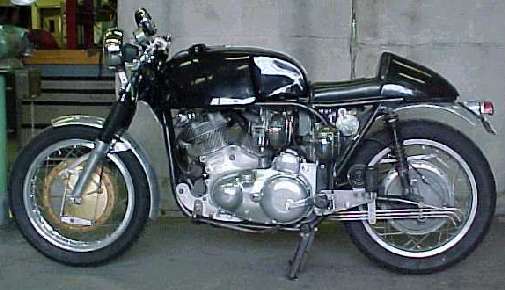
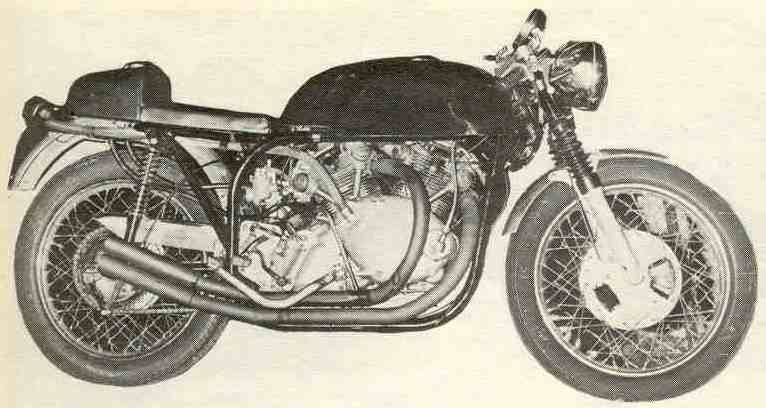
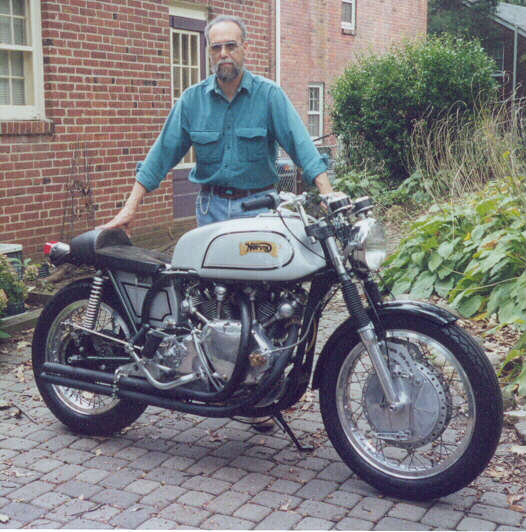
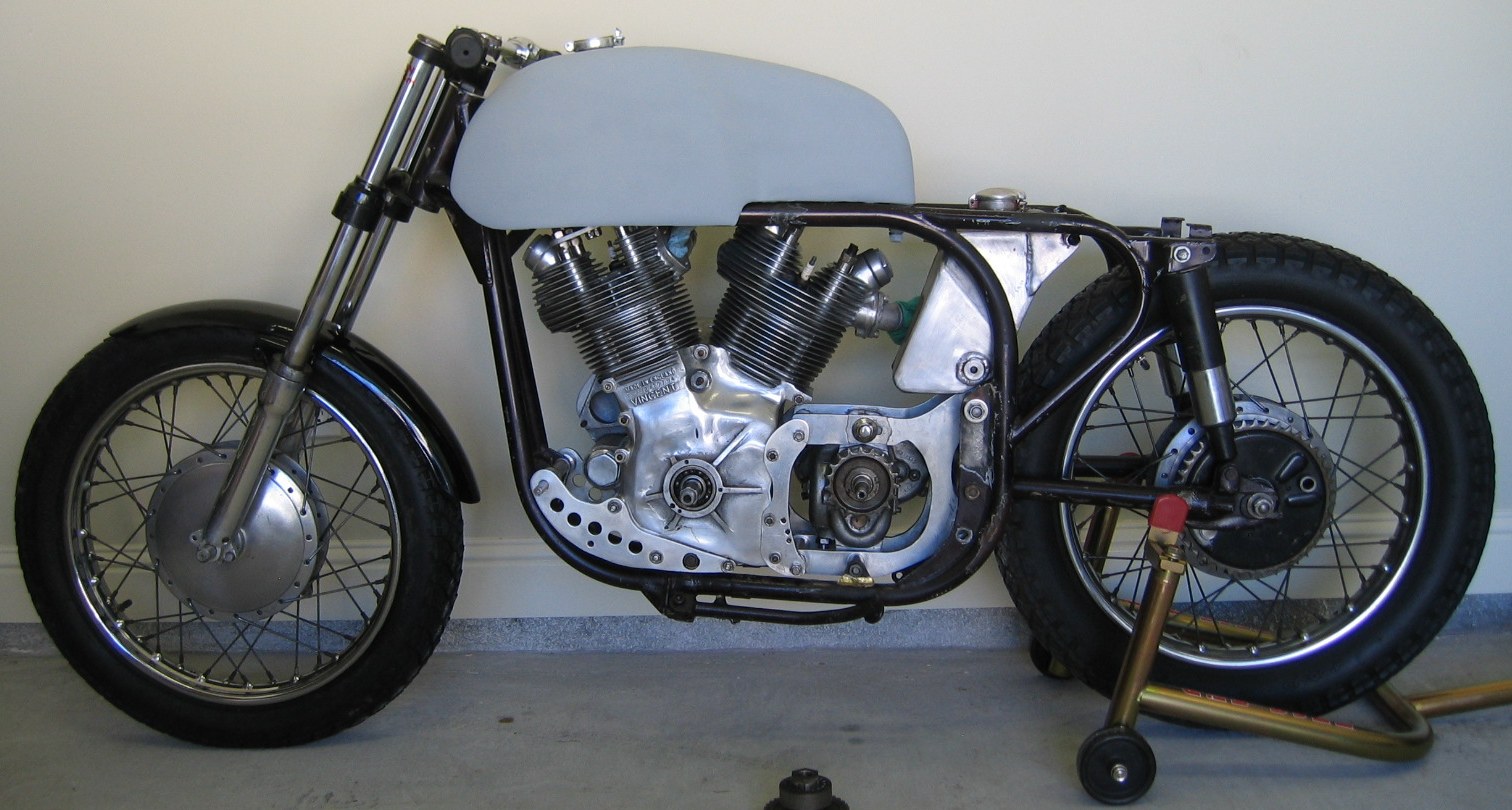

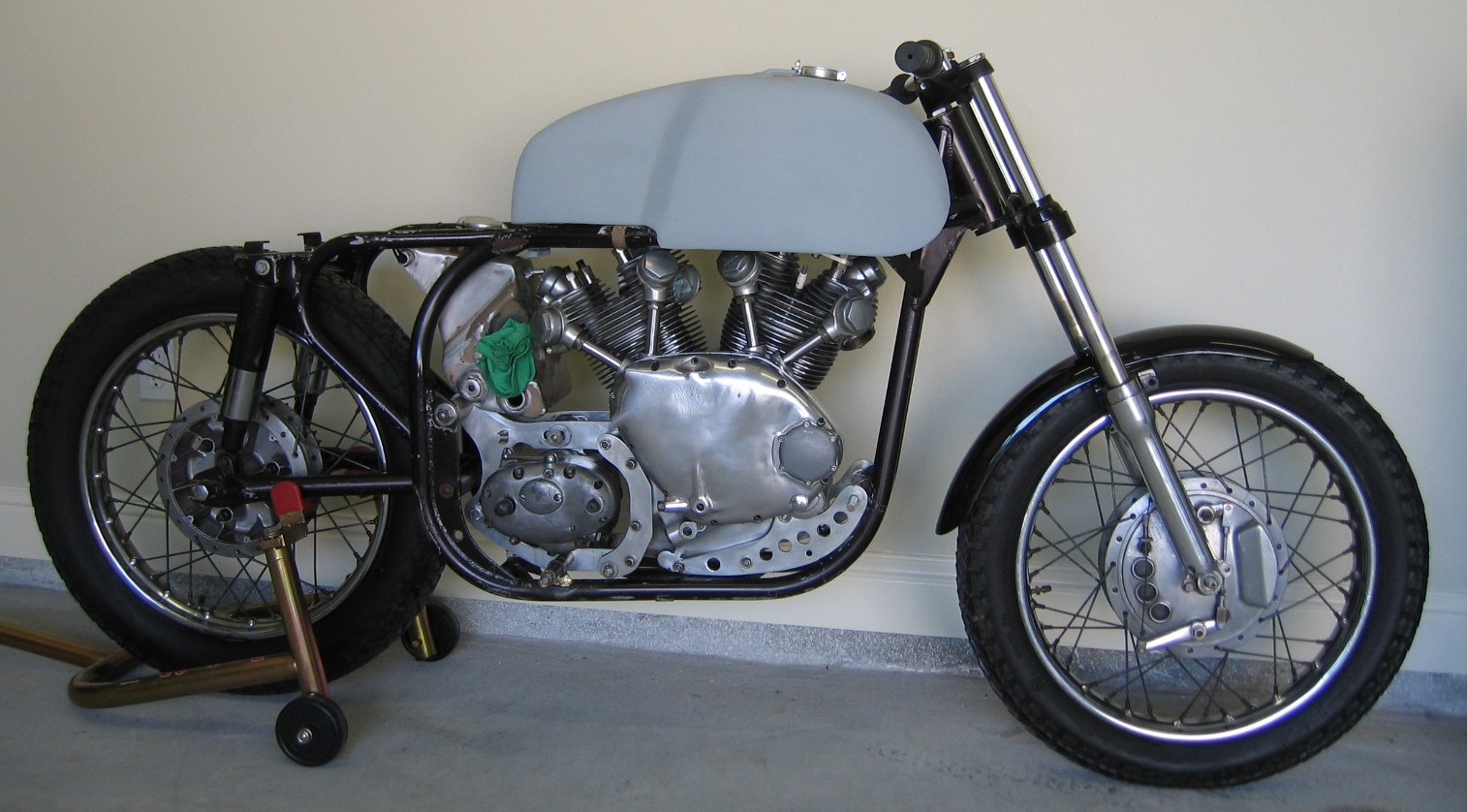

Engine Mounting: Some Norvins, even with
complete frames, have been built with substantial upper engine
mounts. I think that this is a bit of an over kill, but hey, it
probably doesn't do any harm. A sturdy head steady is mandatory
though. The Norvin with the lower frame rails removed is still
around. Known as the Italian Norvin even though it was built in
England and then exported to Australia for the '83 International
rally before going to Italy. Whilst removng the lower frame rails
does allow you to move the engine/gearbox around, I  don't see any further point
in it. One may as well then fit the steering head to the top of the
cylinder heads and then, oh, bolt the swinging arm to the back of
the gearbox and remove the rest of the frame and oh gosh, we have a
standard Vincent. Cutting up a Manx frame will
don't see any further point
in it. One may as well then fit the steering head to the top of the
cylinder heads and then, oh, bolt the swinging arm to the back of
the gearbox and remove the rest of the frame and oh gosh, we have a
standard Vincent. Cutting up a Manx frame will
probably result in you being paid a visit by the Norton Club
linching crew. It's equivilant to cutting the gearbox off a
Vincent engine. Besides there is something visually appealing
about the Vincent unit being "Framed" by the Norton
Featherbed. Phelps 6/9/07
I built a Norvin a few years
ago and found it uncomfortable and top heavy. The engine
necessarily has to sit high in the frame as you can't get it to sit
between the lower frame rails (as the manx engine does), so raising
the C of G. The wideline frame makes an uncomfortable riding
position and makes kickstarting difficult. I eventually sold it as i
found i was not using it. With a standard twin and single in the
garage alongside the norvin, i always chose one of the other bikes
when going for a ride. The Norvin looked beautiful but I found it
not very practical.
If I had the chance again I would build an Egli or probably a
Vincati. Much more user friendly for an octogenarian, and there is
lots of information out there with the ozzy, and not least, Big
Sids, Vincatis. Les Craggs 5/14/07
Check out the way Dave Dresda does his featherbed for Vincent - the bottom
rails are spread to get the engine to sit down low - a nice
compromise and the rear lug isnt chopped ! . And of course, use the
two piece cylinder studs so you can pull the heads off with the
engine in the frame. Terry Prince has some really nice Stainless
ones.
http://www.dresda.co.uk/bikes2.asp?CAR=9
Norvin Frame:
If
I were to build a Norvin I would cut the tubes connecting the left
and right frame loop, spread it a bit apart and start from there.The
aim is to get the engine as low as possible as it is so heavy. Even
ín the original Egli the engine sits a bit high - on my second frame
I lowered it 1,5 inches without any harm or ground clearance issues
and was rewarded by a much nicer ride and better handling bike.
Don´t know about Vincatis but all the pictures I saw of them seem to
have the engine on the high side as well. When building race Nortons
etc I always try to get the crank below the wheel hubs - as low as
possible and as much forward in the frame as well. The little blue
Norton got 78 kg on the front wheel and 62 on the back - with rider
this gets an almost even load on both wheels and is noticable when
comparing the feeling to an ordinary Atlas. Next plan is a Dunstall
frame where the front wheel almost rubs the fins of the motor when
fork is compressed....
I would not cut the original Manx frame however - sell it and
have a wider featherbed made for that money -might probably leave
you with some extra
cash in hand and a better suiting frame. Hartmut
5/15/07
General Comments:
My Egli, Norvin and C Shadow all share the same 56 inch wheelbase,
give or take for rear wheel adjustments (a Ducati bevel has a 61
inch wheelbase for comparison). The Egli and the Shadow both
have the crankshaft 24 inches behind the front wheel, the Norvin
26.5. The limiting factor on the forward placement of the Norvin
engine was the front exhaust pipe, which still required 'massaging'
to clear the front down tube (with chopped cases I need the full
frame). The Norvin crank is also a couple inches further back than
standard Norton, as I found out when I tried to use a Norton primary
cover. I did make the Norvin gas tank shorter than the Egli's
so I can sit further forward. I thought the Norvin was going
to be heavy but it's coming out OK, the AMC box must save some
weight.
The Egli and Norvin both have the same length Ceriani RR forks
and tires, both sit in the same location in the trees so the
steering heads are appx. the same height.
Paul Zell 5/16/07
General Comments:
I lifted the swingarm shaft by 4mm lowered and tilted the engine
(not much) and used a smaller rear wheel ( 18"instead of 19"). When
upgrading the front brake I had to use a wider/higher tire as the
19"Speedmaster couldn´t handle the braking forces, washed out on
many bends and was used up within 500 km. So the front fork was
shortened a bit as well. No negative feedback from the slightly
different swingarm angle but I don´t ride the thing anymore as the
Norton is so much lighter, does the same topspeed and is more fun
when it gets twisty. Hartmut 5/15/07
General: Well ,
having built both an Egli and a Norvin recently: I cannot
think of a single drawback of the Egli style frame in comparison to
the featherbed. The featherbed has compromises in engine
location, carb and exhaust clearance, separate oil tank...
There are however arguments to be made for using what you have on
hand and building something nostalgic and eye pleasing. If it
weren't for this we'd all be riding new bikes, no?
I had chopped cases which made sense for a featherbed since the
standard Vin twin swing arm pivot is gone, the featherbed
obviously has one and also the AMC gearbox is right there already
mounted. With removable cylinder studs the heads and barrels
come off in the frame. A chopped engine also sites a bit
lower in a featherbed than a complete. I thought long and
hard about spreading the lower rails but in the end did not
because my crankshaft sits just about lever with the AMC gearbox
mainshaft already.
With the swing arm pivot on a Vin twin (standard chassis or Egli)
incorporated in the design the height of the engine directly
determines the angle of the swing arm. My Egli engine looks
high but with long travel suspension (relative to other vintage
iron) the swing arm is level when I am on the bike. There is
no way to lower the engine without having the swing arm at a
unfavorable angle, tilting the front of the engine down
substantially or using 16" wheels. Paul Zell 5/16/07
Norvin Brakes:
(4LS front wheel between Norton Commando forks) I`m working
with a front hub from a water buffalo (Suzuki GT750) and I`ve
milled about as much from the brake plates as possible without
removing the speedo drive in order to get it between the
forks...still don't have the room between my forklegs. There were
different sized Norton steering crowns and I'm wondering if
I`ve got the narrowest one ? Anyone know what the different sizes
& models were? Or is this the best reason every for custom
aluminium steering crowns ? Marc Beaudry 4/17/03
Norton Forks:
I always deal with the Norvil Motorcyle Company if I want Norton
parts. Les Emery, the boss is a mine of
information and will give you any information you want.
There are certainly two widths of fork yokes listed in their free
catalogue - 7inch and 7 3/8 inch centres. Contact
Les at :+44 (0)1543 278008 or e-mail at
mail@norvilmotorcycle.co.uk. Derek Peters
4/17/03
Build details of Ken
Phelp's Norvin: I have built both my Norvins (the other is a
racer) and have been using my road bike as a daily ride for well
over twenty years. The bike as it is in the photo runs a
250mm 4LS Magnesium Fontana front brake, and a Laverda 2LS rear
brake. Norton forks are really early sliders with late internals.
1956 Norton Dominator frame with Koni shock absorbers. The fuel
tank is of unknown origin, possibly Dresda and the seat is my own
aluminium alloy ducktail and base. Black Shadow speedo and Triumph
headlight. The engine has been detuned of late to cope
with the crudy petrol on offer but still runs 36mm Dellorto pumper
carbys' on matching long manifolds and ports. Std valves are
opened by Lightning cams onto 8.2:1 pistons with ignition by the
standard Lucas magneto. The exhaust is my own fabrication using
slightly larger diameter thicker wall pipe into a straight through
resonator megaphone 'Muffler'. The rest (oil tank, foot controls,
bracketry, piping etc.) are of my own construction.
My Norvin has a Yamaha 270(?) mm 4LS front brake in 7" (narrow)
Roadholders, not Commando forks, but the sliders are basically the
same. However, you need to measure the center to center
distance of your fork tubes, then you will know if you have the
narrow or wider triple clamps and what your options are. If
you also look at the bottoms of your sliders you will see that there
is an inward projecting shoulder on each one. You can mill a
fair bit off each of those to get more clearance. I assume you
have removed the original brake plate retaining boss on the backing
plate side. David Stein 3/26/03
Phelps Norvin:
The bike as it is in the photo runs a 250mm 4LS Magnesium Fontana
front brake, and a Laverda 2LS rear brake. Norton forks are really
early sliders with late internals. 1956 Norton Dominator frame with
Koni shock absorbers. The fuel tank is of unknown origin, possibly
Dresda and the seat is my own aluminium alloy ducktail and base.
Black Shadow speedo and Triumph headlight. The engine
has been detuned of late to cope with the crudy petrol on offer but
still runs 36mm Dellorto carbys' on matching long manifolds and
ports. Std valves are opened by Lightning cams onto 8.2:1 pistons
with ignition by the standard Lucas magneto. The exhaust is my own
fabrication using slightly larger diameter thicker wall pipe into a
straight through resonator megaphone 'Muffler'. The rest; oil tank,
foot controls, bracketry, piping etc. are of my own
construction. Ken Phelps 3/27/03
Norvin Notes:
www.voc.com.uk/ogri
has the photo build history of the bike I am effectively copying,
and notes relating to parts and services suppliers (but please note
that Asa Moyce of Bartel (Northern Ireland) no longer makes the
combined oil / fuel tanks, but still makes fuel-only Manx etc.
tanks. Instead, enquirers can be referred to TAB Engineering
(Mr TA Baker of Aberystwyth, West Wales, UK) on tel. +44 1974
821469.
Other items to be borne in mind for Norvin builders using an
unchopped Vin Twin engine: if using a Grimeca rear hub, it's
necessary to do transpose the relative positions of the torque arm
anchor and brake cable abutment points for left-hand operation,
and of course to weld a corresponding torque arm anchor tab on the
left hand side of your box-section swingarm. These Grimeca
cush-drive rear hubs come poly coated in black, so I have had all
4 exterior hub component surfaces garnet- then bead-blasted bare
to take a nice polish on the bare alloy. I've also had the
alloy wheel sprocket turned down for a 1/4 in chain.
Also necessary on frame: cut and weld to half thickness the
left-hand bottom tube where it blends with the L/H gusset plate,
and cut back the gusset plate itself to accommodate the L/H
crankcase lug co-axially with the S/A spindle pivot point.
For this you must also mill a 1/4 slot roughly central through the
lug on a horizontal miller, but not so deep as to break through
into the chaincase. Also, the chaincase part of the casting
has a curious circular projection underneath which must be ground
off; in fact you should grind a little further back the metal in
that area (i.e. chaincase bottom rear) for best bedding with
bottom rail / gusset plate junction..
Photo of my own swingarm attached herewith. Currently I'm
opening out the slots and blocks and making new shouldered sleeves
for the wheel spindle, as my Grimeca centre is 17mm, but Pete
Lovell who makes the Norvin swingarms built mine for a smaller
spindle. Too bad it was already polished and bright nickel
plated, but I'll know next time.
It should be remembered that some Norvin builders dispense with
the featherbed frame's bottom tubes entirely (viz. the Itlian
Norvin from MPH magazines passim). They don't bear any load
anyway if the head-steadies are effective, and could therefore
retain the standard Vincent crank balance factor. It could
be argued that this latter approach allows the engine to be
dropped slightly lower at the front for lower C/G and to enhance
the handling, but the Ogri Norvin hadled superbly by all
accounts. With bottom tubes in situ, the Ogri engine was as
low as it could be consistent with box-spanner access to the sump
drain plug.
It would be nice to enquire whether the current owner of the Ogri
Vincent (last heard of he was a Swiss gentleman) is willing to
share his experiences with the rest of us. Phil Blakeley
2/1/03
Return to: Home Page of thevincent.com